
Since 2016, TNQ Inspiring Science Awards (TNQ ISA) has been celebrating creative and impactful research in life sciences by rewarding the young researchers involved in the work. Four PhD students and a postdoctoral fellow from CSIR-Centre for Cellular and Molecular Biology (CCMB) have been on this list of finalists so far. The latest one this year was Dr Jotin Gogoi who authored a paper on how cells tolerate some mistakes in making proteins and how this might have helped in the evolution of living cells.
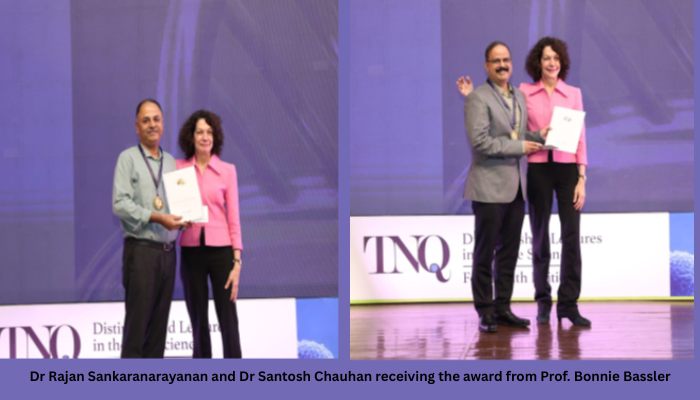
This year, TNQ ISA has also recognised two mentors, both affiliated to CCMB, for their exceptional mentoring of young researchers. Dr Rajan Sankaranarayanan and Dr Santosh Chauhan have trained four researchers each, whose work has been recognised by TNQ ISA. The concerned PhD students trained under Dr Chauhan were enrolled in the BRIC-Institute of Life Sciences, Bhubaneshwar. This move by the awarding agency highlights the importance of mentoring young researchers towards exciting and meaningful work.
Dr Sankaranarayanan’s research group focuses on understanding how structures of enzymes dictate their unique properties, which are also essential to life. One of their major focus areas is studying the living cell’s machinery to select the right orientation of amino acids to make proteins. Dr Chauhan’s research group looks into the cell’s first line of defence against outside invaders, called innate immunity. His work has opened up a new line of research called Programmed Cell Revival – it lets us understand how cells on the brink of death have hard-wired molecular mechanisms to revive themselves.
On the occasion of receiving the award, both the senior scientists of CCMB reflected on the important role young researchers play in their groups through not only doing experiments but also their creativity and energy.
On the style of mentorship, Dr Chauhan remarked, “For me, mentorship is not about telling people exactly what to do. It’s about giving them space to think, ask questions, make mistakes, and slowly become confident and independent scientists. When I see someone grow in that way, it feels more rewarding than any single result or paper.”
Dr Sankaranarayanan also commented on the basic questions of life sciences that his lab addresses. He said, “Awardees from my lab have worked on very fundamental problems in biology, rather than on fashionable topics or work with immediate application relevance. I really appreciate that the TNQ jury has recognised such fundamental work, and I hope this will encourage young scientists to continue to take up basic biological problems.”

