
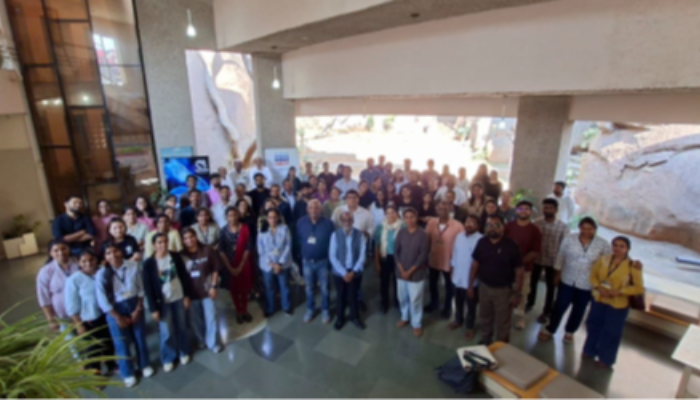
CSIR-Centre for Cellular and Molecular Biology (CCMB), Hyderabad, at its Laboratory for the Conservation of Endangered Species (LaCONES) campus, hosted a four-day workshop and symposium titled “Discerning the Eastern Ghats: From Genes to Landscapes” from 18–21 February 2026 at LaCONES, Hyderabad. The event brought together researchers, students, conservation practitioners, NGOs, and government agencies, such as the forest department officials from across India, to deepen scientific understanding and conservation planning for the Eastern Ghats.
The Eastern Ghats represent one of India’s most complex and little-understood mountain systems. It stretches as fragmented hill ranges across the eastern part of the country and blends gradually with both the Western Ghats and the forests of eastern India. It has a much older geological origin and different ecological histories from the Western Ghats. Much of its diversity remains poorly documented and is increasingly vulnerable to habitat loss, fragmentation, and climate change. The symposium provided a much-needed platform to refine perspectives on its biogeography, ecological processes, and conservation priorities.
1. Bridging scales: from genes to ecosystems: studies at LaCONES-CCMB have estimated the biodiversity of the Eastern Ghats using the environmental DNA method. Unlike the traditional methods of checking DNA from biological samples, environmental DNA analyses allow scientists to detect genetic material that organisms shed into the environment. Using that, LaCONES-CCMB scientists estimate a rich biodiversity inhabiting the Eastern Ghats, including insects, arthropods, fish, reptiles, birds, mammals, plants, and even micro-organisms. These include organisms that are otherwise undocumented in the region.
The meeting integrated these findings with insights from landscape-level ecology studies. Speakers emphasised that effective conservation planning must connect information from genes, species interactions, entire ecosystems, and landscape-level data such as spatial information on land-use patterns, habitat connectivity, topography, and satellite-derived land cover maps. This will allow the management to identify vulnerable populations, detect hidden diversity, prioritise restoration sites, and develop climate-resilient conservation strategies. This will ensure that protection efforts are scientifically informed as well as practically effective.
“Combining genomic tools, species-level research, and large-scale ecological studies can help us better understand how species originated and spread, how habitats have changed over time, and what areas require urgent conservation attention in the Eastern Ghats,” said Dr Umapathy, Chief Scientist at LaCONES-CCMB and convener of the meeting.
2. Diverse disciplines, shared conservation goals: speakers from institutions including IIHS Bengaluru, IISER Tirupati, NCBS Bengaluru, BSIP Lucknow, IISER Thiruvananthapuram, NIAS Bengaluru, NRSC Hyderabad, ZSI Hyderabad, IISER Bhopal, and LaCONES-CCMB presented cutting-edge research spanning freshwater ecology, forest-grassland dynamics, pollination biology, animal behaviour, remote sensing, environmental DNA, ancient DNA, systematics, and conservation genomics.
A delegation of 70 participants, including Master’s students, PhD scholars, postdoctoral researchers, faculty members, forest officials, and NGO representatives, engaged in the symposium talks across ecological and evolutionary scales.
3. Intensive genomics workshop builds capacity: the symposium included an intensive, hands-on workshop on using genomics tools designed for novice learners with little or no prior experience in bioinformatics. PhD scholars, postdoctoral fellows, as well as faculty members of colleges and research institutes were introduced to the fundamentals of genomics and high-throughput sequencing technologies.
Through guided practical sessions, participants learned genomic data processing, genome assembly, statistical analyses, genome annotation, visualisation, and biological interpretation. The workshop aimed to build technical capacity and empower researchers working in the Eastern Ghats to integrate genomic tools into their ecological and conservation studies.
“It needs a community of scientists who can work in the field as well as comprehend genomic data. Only then we can build collaborative networks and integrate state-of-the-art conservation strategies for India. And, the underexplored biodiversity of the Eastern Ghats calls for it urgently,” echoed Dr Siddharth Kulkarni and Dr Gopi Krishnan, the co-organisers of the meeting.

