
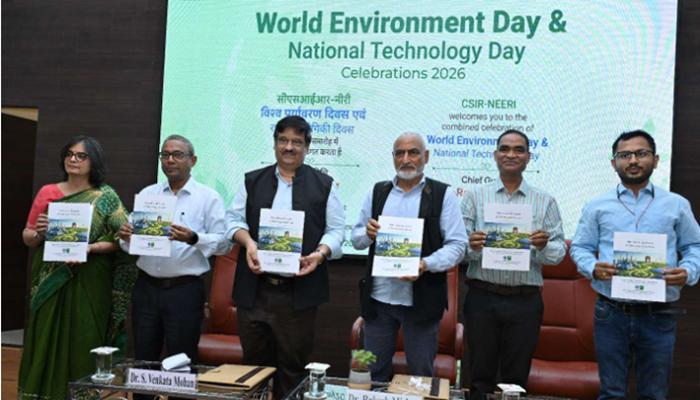
CSIR-National Environmental Engineering Research Institute (CSIR-NEERI), Jorhat, celebrated World Environment Day on 5 June 2026. Dr Rakesh Mishra, Director, Tata Institute for Genetics and Society (TIGS), Bengaluru & former Director, CSIR-Centre for Cellular & Molecular Biology (CSIR-CCMB), Hyderabad, was the Chief Guest and addressed the gathering on this occasion. Dr S Venkata Mohan, Director, CSIR-NEERI and Prakash Kumbhare, Scientist-F, CSIR-NEERI, were also present.
Addressing the gathering on “Environmental Surveillance and One Health,” Dr Mishra highlighted the importance of environmental surveillance in protecting public health. He explained that metagenomics, which analyses genetic material present in environmental samples such as wastewater, air and soil, has emerged as a powerful tool for monitoring pathogens, Antimicrobial Resistance (AMR) and ecosystem health. Referring to wastewater surveillance during the COVID19 pandemic, he noted that environmental monitoring helped detect infection trends and viral variants at an early stage, enabling timely public health interventions. Dr Mishra emphasised that antimicrobial resistance is a growing global concern, and environmental surveillance can help track resistant pathogens and emerging health threats. He highlighted national initiatives such as the Alliance for Pathogen Surveillance Innovations (APSI) and the National One Health Mission, aimed at monitoring pathogens and AMR through wastewater, air and other environmental matrices. Emphasising the One Health approach, Dr Mishra stated that human, animal and environmental health are closely interconnected and require coordinated action. He also highlighted efforts to develop an India-specific One Health Index to support evidence-based policymaking and health preparedness.
Dr Mishra further noted that advances in environmental surveillance, genomics, diagnostics and data analytics are creating new opportunities for early detection of emerging health threats. He called for stronger collaboration among scientific institutions, government agencies and communities to build resilient surveillance systems for a healthier and more sustainable future. In his welcome address, Dr S Venkata Mohan, Director, CSIR-NEERI, recalled his scientific association with Dr Rakesh Mishra in wastewater epidemiology and genomics for public health applications. He emphasised the need for science-driven solutions and stronger science-policy linkages to address environmental challenges. Highlighting CSIR-NEERI’s work in air and water quality management, wastewater treatment, waste valorisation, and eco-restoration, he reaffirmed the institute’s commitment to delivering sustainable environmental solutions for society. Dr Shalini Dhyani, Scientist-E, CSIR-NEERI, conducted the proceedings.
On this occasion, a Memorandum of Understanding (MoU) was signed between CSIR-NEERI and TIGS to strengthen collaborative research and innovation. Two White Papers, “Industrial Ecology in the Indian Context” and ‘Environmental Health Risk Atlas and Action Framework for the Vidarbha Region’, were released. The book “Fungal Diversity in CSIR-NEERI Nagpur” was also unveiled. Certificates of Excellence were presented by the Chief Guest to students who participated in the Student Research & Innovation Expo in recognition of their innovative ideas and working science models.

