
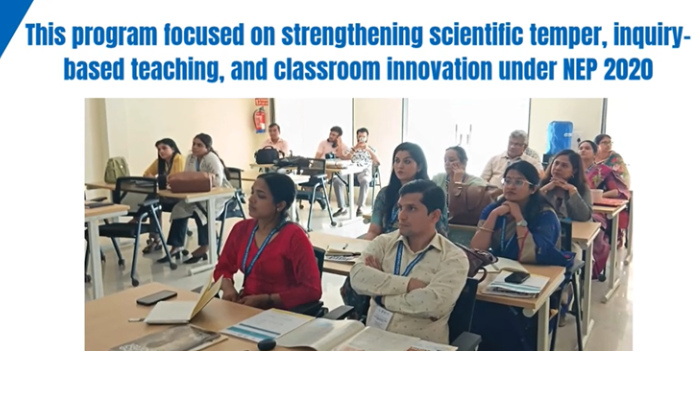
Teachers of Tomorrow is a comprehensive professional development initiative introduced by the United Schools Organisation of India (USO). The programme is designed to empower educators and enhance their capabilities beyond the traditional classroom environment. It provides a dynamic platform for teachers to engage in continuous learning through a diverse range of activities such as seminars, workshops, competitions, and webinars. Each component of the series is thoughtfully curated to address the evolving needs of educators in the 21st century, enabling them to adapt to modern pedagogical practices and foster holistic development among students.
The initiative focuses not only on strengthening academic competencies but also on nurturing essential skills such as communication, collaboration, and innovation. By encouraging educators to stay updated with contemporary educational trends and policies, Teachers of Tomorrow aims to build a community of forward-thinking teachers who can inspire and guide learners effectively. The Professional Development Programme titled “Teachers of Tomorrow: Advancing Scientific Temper under NEP 2020” was successfully conducted on 25 March 2026, at the Einstein Meeting Room, USO House, New Delhi. The programme was organised by USO in collaboration with CSIR–National Institute of Science Communication and Policy Research (CSIR-NIScPR).
This initiative brought together science educators from various schools across the region, creating a collaborative platform for knowledge exchange, skill enhancement, and professional growth. The programme was aligned with the vision of the National Education Policy (NEP) 2020, which emphasises experiential learning, critical thinking, and the development of a scientific temper among students.
The workshop provided participants with valuable insights into innovative teaching methodologies and the importance of integrating scientific inquiry into everyday classroom practices. It also highlighted the crucial role of teachers in shaping young minds and fostering a culture of curiosity and evidence-based reasoning. Through a series of expert-led sessions and interactive activities, the programme created an engaging and enriching learning experience for all attendees.
The primary purpose of the program was to empower science teachers with innovative pedagogical approaches that promote curiosity, critical thinking, and evidence-based learning. In line with the objectives of NEP 2020, the workshop focused on advancing scientific temper by encouraging inquiry-driven teaching methods and strengthening the ability of educators to communicate scientific concepts effectively.
Another key objective was to emphasise the importance of ethical practices in scientific writing and communication. Teachers were encouraged to adopt strategies that not only enhance students’ understanding of scientific concepts but also instil values such as integrity, accuracy, and objectivity.
The programme also aimed to bridge the gap between theoretical knowledge and practical application. By introducing experiential learning techniques and real-world examples, educators were able to create more engaging and interactive classroom environments. This approach ensures that students are not passive recipients of information but active participants in the learning process.
The programme commenced with the registration of participants, followed by an inaugural session that set the tone for the day. The opening remarks and welcome address were delivered by Ms Nina Jain, Secretary General, USO, who emphasised the significance of continuous professional development for educators and the role of such initiatives in strengthening the education system.
The inaugural address was delivered by Mr CB Singh, Head of Jigyasa, Training & HR Division at CSIR-NIScPR. In his address, he highlighted the importance of scientific literacy in today’s world and underscored the vital role that teachers play in nurturing informed and responsible citizens. He also spoke about the need to cultivate a spirit of inquiry and innovation among students.
The first technical session was conducted by Ms Sonali Nagar, Editor of Science Reporter. Her session, titled “Science Beyond the Textbook,” focused on the importance of moving beyond rote learning and encouraging inquiry-driven education. She discussed effective science communication techniques, the development of scientific writing skills, and the importance of maintaining integrity in scientific practices. The session was followed by an interactive segment, where participants engaged in assignments and reflective exercises, allowing them to apply the concepts discussed.
Following a lunch break, the second technical session was led by Dr Manish Mohan Gore, Editor of Vigyan Pragati. His session on the “Role of Science Communication in disseminating research outcomes of Indian laboratories and its significance in science teaching” provided valuable insights into how teachers can connect classroom learning with ongoing scientific advancements in the country. He emphasised the importance of making science relatable and accessible to students by linking it to real-life contexts and current research.
The session also included an interactive component, where participants actively shared their perspectives and reflected on their learning. These discussions fostered a collaborative learning environment and encouraged the exchange of ideas among educators.
The program concluded with closing remarks and the distribution of certificates to all participating teachers. As a token of appreciation, goodies were also provided by the USO to the participants. The event ended with a group photograph and a tea session, offering an opportunity for informal interaction and networking.
Overall, the sessions were thoughtfully curated to maintain a balance between theoretical insights and practical engagement. The workshop proved to be highly informative and impactful, leaving participants better equipped to implement innovative teaching strategies and promote scientific temper in their classrooms.

